

We Sell Automation, So Why Is Our Onboarding Still Manual?
Updated: Oct 13
From homeowners and integrators to manufacturers, rep firms and distributors, it's time to rethink the first experience we give those who pay our bills.

How much could we learn about your business before asking you a single question? Give us your company name. We'll do the research and send you a private onboarding form already filled with what we found. See how much we get right. No sales pitch, no obligation, just a chance to see what's possible when you do the homework first.
We automate million-dollar homes, then email a PDF?
We can automate every light, shade, television and climate system in a home, but apparently we still need six emails and three PDF forms to open a dealer account. We promise homeowners technology that works together, then welcome new partners with printed applications, separate credit forms, emails asking for information they already gave us and calls because someone lost the attachment. Then we make them wait thirty days for approval when they need the product tomorrow, which is a strange way to make a sale.
Most of us have lived some version of this, and most of us have quietly accepted it as the cost of doing business.
The four onboarding problems nobody talks about
This isn't one company's problem, it runs through every relationship in our channel.
Relationship | Typical friction | What a better experience looks like |
Integrator → Homeowner | Repeated discovery questions, with proposals, selections, documents and updates scattered across email | One shared project profile that grows from inquiry through installation and support |
Manufacturer → Dealer | Applications, certifications, territory checks, price-list requests and training records handled separately | A prefilled dealer profile with requirements and approval progress visible |
Rep firm → Dealer | A different application for every line the rep carries, repeated introductions and disconnected follow-up | One organized dealer record that feeds every brand in the rep's bag |
Distributor → Dealer | Account applications, tax certificates, credit terms, reseller verification and pricing access | A guided account opening that collects documents once and shows approval status |
Some paperwork is legally or commercially necessary, and nobody is suggesting we skip credit reviews, verification or signed agreements. The opportunity is to stop the duplication and make the legitimate requirements easier to complete.

One rep firm, ten brands and ten different applications
I spent years as a rep, and this one still frustrates me. A dealer works with one rep firm carrying ten lines, and each manufacturer has its own portal or PDF, its own credit form and its own way of asking for the same business name, tax certificate, references and showroom photos the dealer has already handed over nine times.
The rep is stuck in the middle chasing paperwork, and when an approval takes thirty days while the client needs product today, the job goes to whatever brand the dealer can buy this afternoon.
With everything about that dealer already online and ten previous applications in the rep’s files, why isn’t anyone taking this off the dealer’s plate? Send a prefilled onboarding form built from their website, public records and, with the dealer’s permission, what they already supplied for the other brands in that rep’s bag. The dealer reviews it, corrects what’s wrong, signs and gets back to work.
That isn’t a technology problem as much as a decision to respect the dealer’s time.
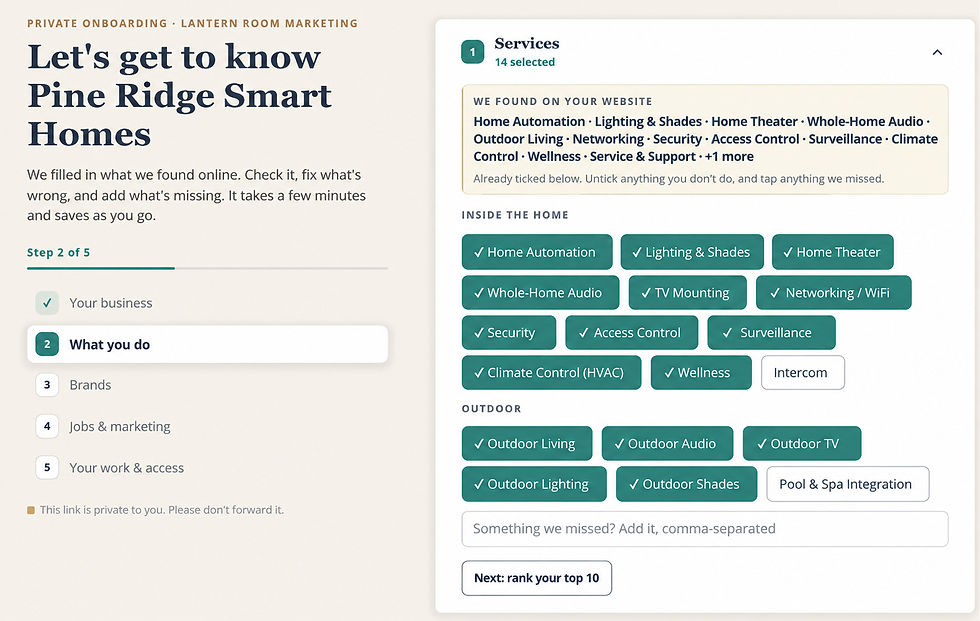
The information already exists, so why are we asking again?
Manufacturers can learn a great deal about a prospective dealer from its website, public records and existing partner relationships and distributors shouldn’t make an established integrator retype every basic detail into another disconnected system.
The better model is research first and verification second. Prefill what reliable sources show, flag what still needs confirming and ask the person to correct, complete and authorize.
A prefilled form doesn’t mean we know everything about you, it means we respected your time enough to learn what we could before asking.

The real problem isn't the form, it's everything after it
A dealer completes the manufacturer's application, and sales has the information. Does the rep firm? Does technical support, training or accounting?
A homeowner tells the salesperson something important. Does the project manager know, or the programmer, or the service technician who arrives two years later?
A distributor approves a new dealer. Are thier purchasing permissions, pricing, contacts and credit status in front of the right teams?
We collect information once and then keep losing the context. That's the bigger failure, and it shows up as delays, unnecessary calls, avoidable mistakes and frustration on both sides of the relationship.
What onboarding should look like in 2026
Research what can be established from business records, relationships and public details.
Prefill a profile so the person confirms it, fills in what’s missing and completes the approvals that matter.
Connect the right people with clear responsibilities, permissions, status updates and next steps.
Keep it alive as a client profile that grows and updates over the years instead of starting over.
The principles are simple. Don’t force unnecessary account creation, let people save their progress, show where an approval stands and never ask anyone to repeat what you already have. Handle documents securely, respect permissions and keep a person in charge of sensitive decisions like credit.

AI didn't invent this problem, but it removes most of the excuses
AI can research a business, website, social media, organize submissions, spot missing fields, route questions and put the right information in front of the people authorized to see it. Building a prefilled dealer form from a website and ten prior applications is exactly the kind of work it handles well.
It isn’t the whole answer. Without a defined approval process, a clear owner of customer information and consistent handoffs, AI just adds another layer of confusion, so redesign the workflow first and then automate it.
Stop asking technology to fix a process nobody has bothered to define.
The first experience is part of your brand
A manufacturer can spend millions building a premium identity and then greet a prospective dealer with a thirty-day application maze. An integrator can advertise effortless living and then make a homeowner chase project details through six email threads. A distributor can promise exceptional dealer support and still make it hard to open an account or find out where an application stands.
People form their opinion of a company long before a single product ships. You cannot market a frictionless experience while running a high-friction business.
Don't take our word for it. Open our onboarding, send us your company name and see how much of your profile is already done before you type a thing.
Where Lantern Room comes in
At Lantern Room Marketing, we've started applying these principles to our own dealer onboarding, replacing blank questionnaires and repeated email requests with research-driven, prefilled profiles and a simpler approval process.
The same thinking works for integrators, manufacturers, rep firms and distributors. If your onboarding still runs on paperwork, repeated questions and endless email chains, it may be time to rethink it, and we can help.
Our industry has spent decades making technology easier for homeowners while making it unnecessarily difficult for people to do business with us, and that's the part worth fixing.
For Integrators
Know Your Market: See how you stack up against the competition in your local market.
Project Studio: Turn your finished installs into project pages that win more jobs.
Meet Sage: The AI assistant that answers your leads and texts so you never miss a job.
Oct 21 Dealer AI Class: Save your seat and learn how to put AI to work in your business.
Integrator First Facebook Group: A community where integrators share what's working and help each other grow.
Rob Skuba
(516) 716-7140
Rob Skuba is a U.S. Army veteran and a 25-year veteran of the smart home and AV industry. He’s worked across every layer of the ecosystem, installation, distribution, manufacturing, design, sales, and consumer education, giving him a 360° understanding of homeowner behavior and dealer growth.
Rob has collaborated with top brands, supported legendary home theater designers like Theo Kalomirakis, and contributed to high-visibility projects from luxury homes to major entertainment spaces for 50 Cent. He’s the founder of National Smart Home, Lantern Room Marketing, Date Night In Stereo, and national awareness events including Smart Home Day, National 10-4 Day and National Headphone Day.
New Dealer: tell us about your business and get your custom marketing plan started.
Dealer Onboarding: step-by-step setup that gets your account, assets and access ready fast.


Comments