

The Future of Smart Home Marketing 2026: From Content to Invoice-to-Asset
Updated: Oct 8
Welcome to The Agentic Web

You feel it.
You’re in the truck after a twelve-hour day, scrolling through analytics and the graph looks like a crime scene. Your traffic has flatlined and the quality of your leads has vanished.
The $1200-a-month blogs your agency churns out with titles like “5 Reasons You Need a Smart Home” are officially dead. Industry data shows that zero-click searches have climbed to 64.5%, and for informational "how-to" queries, that number spikes to nearly 83%.
A "zero-click search" happens when a homeowner asks a question like, "How do I pick the best outdoor TV?" and Google Gemini or Perplexity answers them in four seconds right on the search page. You provided the expertise in your blog, AI scraped it, provided the answer, and kept the user. You got zero brand recognition, so now you or your agency has become an unpaid ghostwriter for the AI that is replacing you.
While you are solving real-world physics, fighting glare in a Bergen County sunroom or managing freeze-thaw cycles on landscape lighting, online you look like a “Ghost Farm.” You look exactly like the guy who started yesterday with a van and a punch-tool.
The smart home industry is changing fast.
In this short explainer, Rob Skuba of Lantern Room Marketing breaks down why generic SEO blogs are losing value, how AI is reshaping search, and why real-world project documentation is becoming the new competitive advantage for integrators.
Watch the video below to learn how the Agentic Web and the Invoice-to-Asset framework may reshape smart home marketing over the next few years.
What is the Agentic Web? (The Death of Browsing)
For twenty years, the internet was a directory, you searched, you clicked, you "browsed." The Agentic Web is the end of browsing and we are moving into a world of Delegation.
By 2029, your customer won't "Google" you, they will just tell their AI Agent: "Find me the best outdoor audio guy in North Jersey who can handle a full-sun install by Memorial Day."
In that split second, the Agent doesn’t browse your site; it audits it. It isn't looking for "5-star vibes", It is looking for Parameters to see if you actually stood on a ladder in that zip code. If your marketing is just a collection of general advice, you don't exist to the machines. To win, you have to stop building a website and start building what we call an Invoice-to-Asset.

GaryVee Was Right: The Internet is Exposing You
If you’ve followed marketing for more than five minutes, you’ve heard Gary Vaynerchuk say: “The internet is not changing us; it’s exposing us.” In 2016, exposure meant a bad review on Yelp, in 2026, it is the death of the Hollow Brand. For a decade, any industry was a smoke-and-mirrors game, you could buy a premium website filled with stock photos of Malibu mansions while operating out of a warehouse in Parsippany. You could hire ghostwriters to write "thought leadership" on systems they had never seen in person.
That was the era of Positioning, the Agentic Web doesn’t care about positioning; it cares about performance. AI Agents use Large Language Models (LLM's) that have read the entire internet and they spot "marketing speak" instantly. When an AI scans a site that is 90% stock photos and generic articles, it assigns a low Trust Score because there is no Unique Signal.
The Exposure:
If you are a "Marketing-First" company with no documentation, AI categorizes you as a commodity.
The Opportunity:
If you are a "Service-First" company, the kind that gets dirty, the internet is finally ready to reward you!
Truth is the New Algorithm
The gap between who you say you are and what you actually do is closing. If you claim to be an "Outdoor Entertainment Expert" but your site hasn't seen a photo of a real backyard install in 5 years, AI exposes you as just another dealer chasing a trend.
The businesses that will dominate 2026–2029 won’t be the ones with the biggest marketing budgets, they will be the ones who are the most documentable. We have to move from the Content Layer to the Proof Stack, this is how you win, by being better at reality.
Section 4: The Shift to Proof (The Transition)
The competitive edge has moved and it’s no longer about saying you’re an expert; it’s about proving you’re a practitioner.
Content = Claims. ("We are the best installers in New Jersey.")
Proof = Evidence. ("Here are photos, a timeline, and a price bracket for a project we finished Tuesday in Westfield.")
The Invoice: Your Most Honest Marketing Asset
This is where most integrators leave money on the table. You finish a $50,000 project, you send the invoice, you get paid, and that data dies in your Quickbooks?
That is a tragedy.
An invoice is the most honest document in your company. It doesn't lie, it doesn't use "marketing fluff," and it contains every single parameter an AI Agent needs to verify your authority.
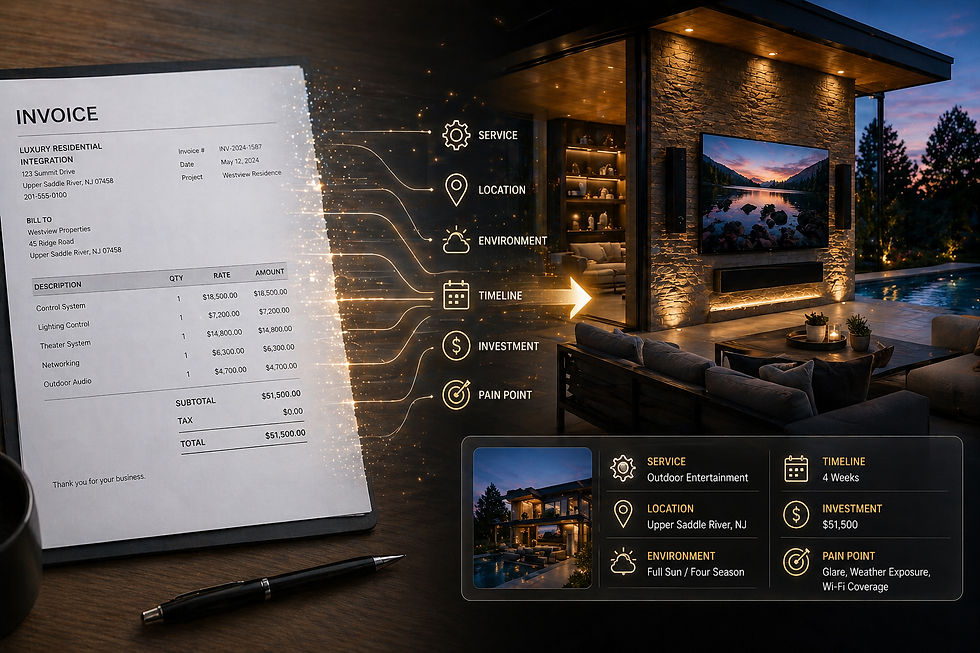
The Invoice-to-Asset Model (The Asset Factory)
In 2026, the goal isn't to write more blogs; it’s to turn every completed job into a digital asset. We call this Invoice-to-Asset—the process of structuring your raw, "in-the-dirt" data so the Agentic Web cannot ignore you.
Most integrators treat projects as one-offs. The value of your engineering evaporates the moment you pull out of the driveway. In the Agentic Web, that is operational suicide.
The Invoice-to-Asset model stops the leak by treating every project as a Data Packet. By stripping sensitive client info and wrapping the remaining data, what was bought, where it went, and the site conditions, in a Context Layer, you create proof that an AI agent can actually use to recommend you.
The Six Signals That Turn Work Into Proof
To feed a machine customer, you can’t just give it a "vibe." You have to give it Parameters. Here are the six signals we use at LRM to turn a standard install into a high-authority asset:
1. The Service (The "What")
Was it a generic "Lighting Install" or a "Lutron Homeworks Retrofit for a 6,000 sq. ft. Estate"? Specificity is the difference between being a "Generalist" and an "Expert" in the eyes of an AI Agent. A generalist gets ignored by the filters; an expert gets selected by the Agent.
2. The Location (The Geographic Anchor)
We don’t need the street address, but we need the town and county. This isn't just for the human; it’s for the Map Pack. When you tag a project in "Charlotte," and post 5 photos with GEO tagging, you are creating a "Near Me" signal that is mathematically linked to that specific geography.
The Commercial Advantage: If it’s a commercial project, name the business (with permission). Tagging a project at a well-known local landmark or a Woodbury shopping center creates a massive trust signal that an AI agent can instantly verify.
3. Environment & Conditions (The "Moat")
This is where you win, AI can’t fake this.
Example: "Full-sun backyard," "High-humidity indoor pool," "Historic home with plaster walls."
When an AI agent sees you’ve solved for "salt-air corrosion" in a coastal town, it flags you as the lower-risk option for the next coastal customer.
4. Timeline (The Efficiency Signal)
"Completed in 2 days." "Same-day service." "Phased 6-month estate build."
Buyers (and agents) want to know the Operational Reality. By documenting the timeline, you answer the customer’s biggest unasked question: "How long is my house going to be a mess?"
5. Investment Range (The Qualifier)
Stop hiding your prices, you don't need to post the exact invoice, but you should post the Bracket.
Example: "This Project was under $15k" "Average projects like this are in the $10k–$25k range."
This does two things: It filters out the tire-kickers, and it tells the AI agent exactly which "economic tier" of customer you serve.
6. The Pain Point (The Search Intent)
People don’t buy gear; they buy solutions to annoyances.
The search isn't: "Speakers."
The search is: "Outdoor speakers that won't annoy the neighbors."
Documenting the specific problem you solved (e.g., "Corrected 10-year-old Wi-Fi dead zones in a 5,000 sq. ft. home") is how you capture high-intent leads.
The Compounding Moat: Your Proof Library
This system isn't a one-time campaign; it’s an Infrastructure Shift. Most of your competitors are lazy, they will continue to pay agencies for generic blogs and stock photos because it’s easy.
Let them, Every time you convert an invoice into a structured asset, you add a brick to your moat. One case study is an anomaly; fifty case studies is a Proof Library. When you have documented dozens of projects across your service area, each with specific environments and timelines, you become statistically unassailable.
Does this require work? Yes. You have to spend five minutes gathering details from the field but that is the difference between a "cable guy" operation and a True CI Business. While your competitors fight for the scraps of "Zero-Click" traffic, you will be building a compounding library of reality. In the Agentic Web, the winner isn't the guy who shouts the loudest; it’s the guy who builds the biggest library of undeniable proof.
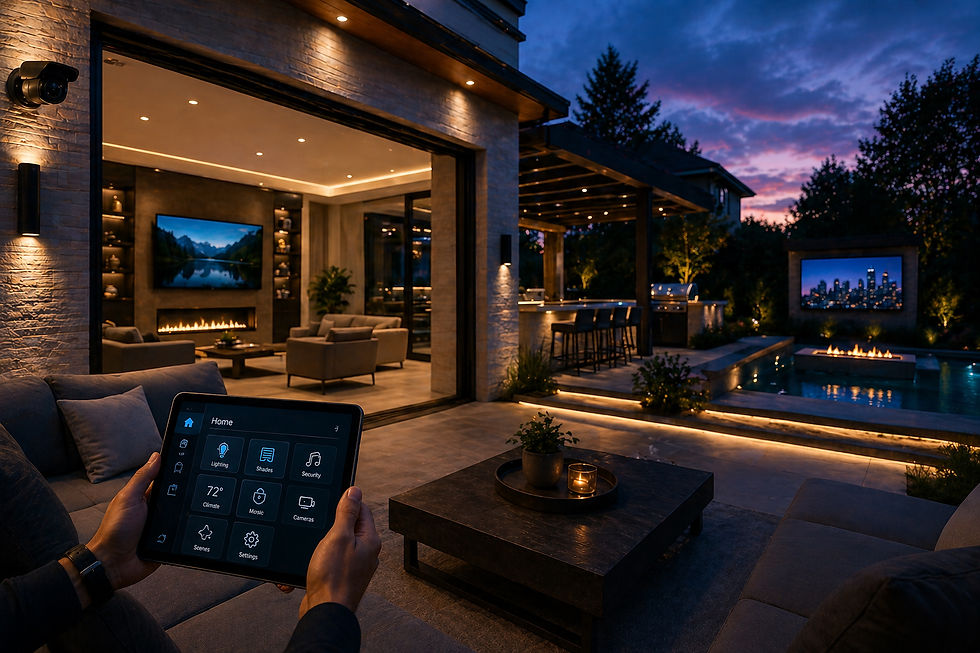
The Future: Beyond the Website
If you view the Agentic Web as just a new way to rank, you’re missing the shift. Your website is no longer the "front door", it is the Validation Layer. Discovery now happens in AI summaries and assistants that narrow choices before a homeowner ever clicks. Your website's role has shifted from finding the customer to verifying the expert.
The Proof Feed Replaces the Blog
Generic blogs are dead because they all look the same. Traditional SEO built on "5 Tips" content is breaking down. The new requirement is Documentation.
A job note from Westfield, a photo of a clean rack, or a 30-second clip on audio placement carries more weight than a thousand words of advice. These are specific, recent, and impossible to fake at scale.
Video: Proof Over Promotion
Lifestyle video shows the "dream," but the work closes the deal. A slow-motion shot of a family is a commodity. A technician explaining a specific design choice shows competence. The future of video isn't production value; it’s useful reality. This is where social video marketing shifts from polished commercials to showing real work in the field.
The Sale Starts Before the Conversation
AI assistants narrow options based on data, not "vibes." When machines audit your business, the company with documented locations, project ranges, and specific outcomes wins.
By the time a lead reaches out, the question has changed:
Old Question: “Can you do this?”
New Question: “How soon can you do for me what you just did in Westfield?”
That is what Invoice-to-Asset is designed to answer.
The LRM POV: The Proof Engine
At Lantern Room Marketing, we don't produce content for the sake of activity. We help integrators turn completed jobs into long-term marketing assets.
Capture:
We help your team document the Six Signals: Service, Location, Environment, Timeline, Investment, and Pain Point.
Structure:
We turn invoices, field notes, and photos into "Agent-Ready" proof.
Compound:
Every documented project adds a brick to your moat, building a record of work that generic competitors cannot match.
Conclusion: Document the Work
Gary Vaynerchuk was right: “The internet isn’t changing us. It’s exposing us.” For smart home companies, the Agentic Web is exposing the gap between those who talk about the work and those who can actually show it. The future of marketing is not generic advice; it is documented reality, structured clearly, and reused intelligently.

If you’re starting to see the gap between your work and how it shows up online, we can help you close it.
Rob Skuba
(516) 716-7140
Rob Skuba is a U.S. Army veteran and a 25-year veteran of the smart home and AV industry. He’s worked across every layer of the ecosystem, installation, distribution, manufacturing, design, sales, and consumer education, giving him a 360° understanding of homeowner behavior and dealer growth.
Rob has collaborated with top brands, supported legendary home theater designers like Theo Kalomirakis, and contributed to high-visibility projects from luxury homes to major entertainment spaces for 50 Cent. He’s the founder of National Smart Home, Lantern Room Marketing, Date Night In Stereo, and national awareness events including Smart Home Day, National 10-4 Day and National Headphone Day.


excellent post