

The Next Luxury Category: Why Simulators Will Follow the Same Path as Home Theater and Smart Homes

Since the 1970's, the custom integration industry has focused on improving how homeowners watch, listen, control, and automate their homes. Home theater created a better movie experience, HiFi audio transformed how music moved through the house, lighting control changed the mood and functionality of a room, and smart home systems simplified how homeowners interacted with technology.
Now another category is beginning to emerge inside the luxury home market, and it will eventually become one of the most emotionally compelling segments the industry has seen in years: simulation environments.
Golf simulators, racing simulators, flight simulators, motion platforms, and immersive entertainment rooms are slowly moving beyond hobbyist culture and entering the mainstream luxury conversation. Most dealers still view these systems as niche enthusiast products, but that mindset may cause the industry to overlook a much larger shift in homeowner behavior.
From Passive Entertainment to Active Participation
The reason simulators matter is that they create a fundamentally different relationship between the homeowner and the room. Traditional entertainment is largely passive; the homeowner watches a movie, listens to music, or scrolls through a screen from a distance. Simulation environments change this dynamic by turning the homeowner into an active participant instead of a passive observer.
This distinction is critical because affluent homeowners are already saturated with screens. They work on laptops all day and move constantly between televisions, tablets, and phones because this experience has become familiar, another display or streaming service no longer generates the same emotional excitement.
Simulators shift the emotional posture of the room, the homeowner is no longer simply consuming content; they are racing, flying, competing, and improving in an interactive environment. This transition from observation to participation makes simulators easier to sell emotionally than traditional smart home categories.
Most integrators know how difficult it is to explain the value of high-performance audio, acoustics, or lighting control to the uninitiated. These categories require demonstrations, education, and patience before the value is clear. Simulators operate differently because the response is immediate. homeowners do not need a technical explanation to understand the thrill of driving a race car or practicing golf in the winter. The appeal is instinctive, providing a significant psychological advantage to dealers who position the category correctly.

Understanding the Homeowner Psychology
The dealers most likely to succeed in this market will not simply focus on simulator hardware because the real opportunity comes from understanding the homeowner psychology behind why these environments are appealing in the first place.
One of the strongest emotional drivers is escape because many affluent homeowners are overwhelmed, overscheduled, and constantly connected to work. They often have the financial resources for hobbies and experiences, but they no longer have the time required to enjoy them traditionally. A simulator compresses the experience into something accessible inside the home.
A homeowner can race for twenty minutes after dinner, practice golf without driving to a course, or spend an hour flying without dealing with weather, scheduling, travel, traffic, or logistics. For many buyers, the simulator becomes less about gaming and more about controlled escape that fits into modern life.
Identity is another major factor because luxury purchases are rarely driven by functionality alone. A wine cellar, a car collection, a private gym, or a theater room all communicate something about the homeowner’s interests and lifestyle, and simulators operate the same way.
For some buyers, the room reflects a passion for motorsports, for others, it represents aviation, golf, technical mastery, competition, or social entertainment. In many cases, the environment becomes part of the homeowner’s identity, which is why presentation and aesthetics matter so much.
Why Design Matters More Than Most Companies Realize
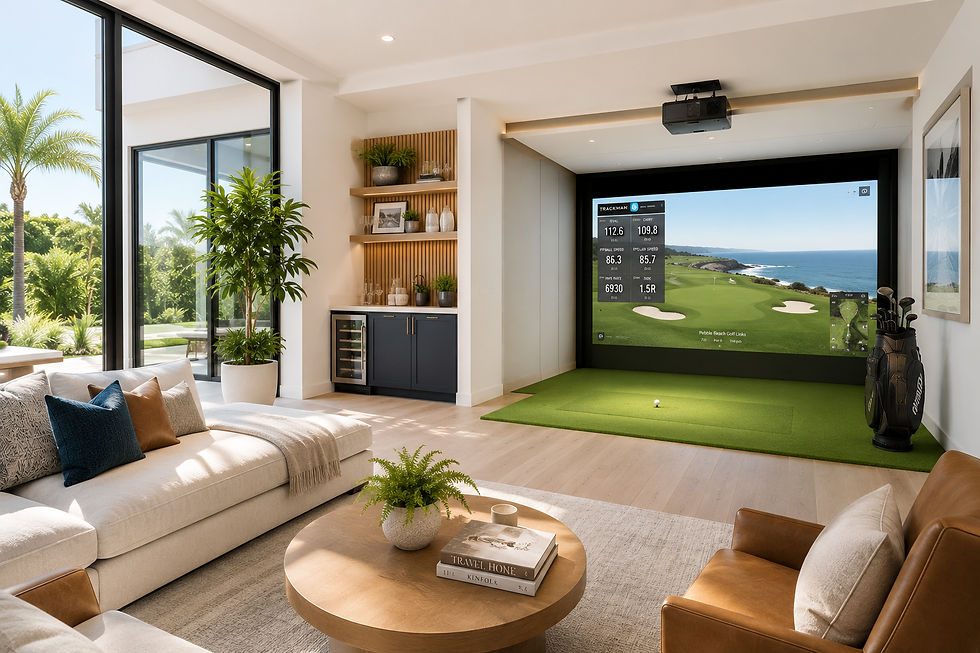
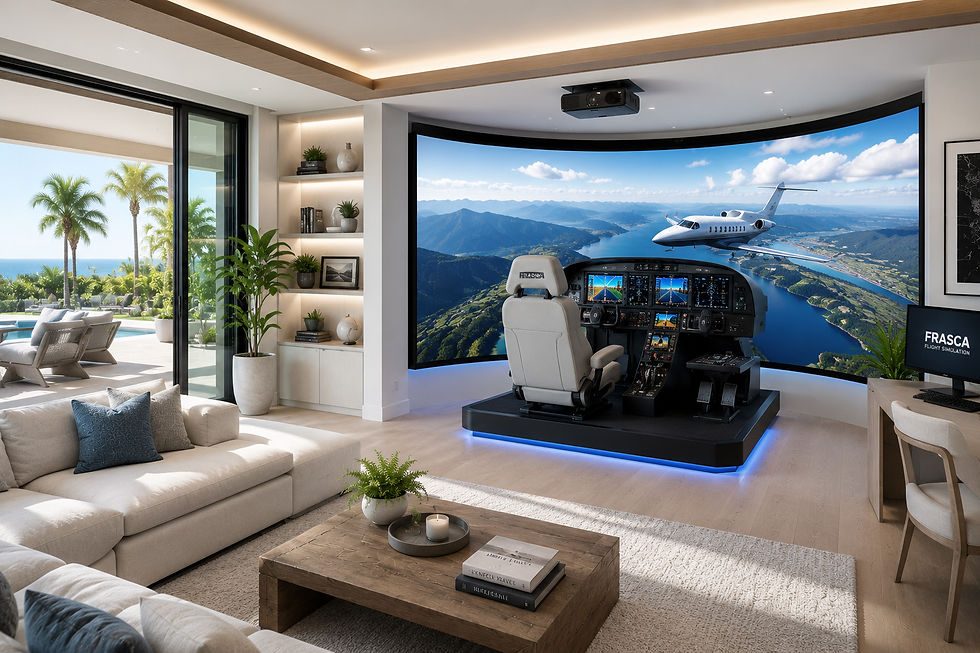
This is one of the areas where many simulator companies currently fall short because a large percentage of today’s systems still look industrial, unfinished, or overly focused on engineering. Exposed metal frames, visible wires, gaming chairs, loose accessories, and hobbyist-style layouts may work in a garage or basement for enthusiasts, but affluent homeowners expect something far more refined.
The dealer’s role is not simply selling a simulator because the real value comes from designing an environment that feels intentional, immersive, architectural, and appropriate for the home itself.
Millwork, lighting, acoustic treatment, seating, cable concealment, flooring, HVAC coordination, and room layout all become part of the value proposition because the homeowner is not simply purchasing a device. They are investing in an experience that should feel premium before the simulator even turns on.
The Reliability and Performance Opportunity
Reliability is another major concern that dealers should not underestimate because homeowners hate technology embarrassment. They do not want software updates, tracking failures, calibration problems, or connectivity issues when friends and family are visiting. The expectation for a luxury simulator environment is simple operation where the homeowner can turn the system on, select the experience, and begin immediately without technical friction.
This creates a major opportunity for integrators because most simulator manufacturers focus almost entirely on the hardware platform itself, while dealers are uniquely positioned to solve the environmental and usability challenges surrounding the experience.
Space planning, acoustics, networking, lighting, display positioning, ventilation, and control integration all fall naturally inside the existing skill set of most custom integration companies. Noise also becomes an important consideration, especially when golf impact sounds, tactile feedback systems, racing pedals, subwoofers, and motion platforms are introduced into shared living spaces near bedrooms, offices, or gathering areas.
These concerns are not weaknesses for the category because they create opportunities for integrators who already understand room performance and environmental design better than most direct-to-consumer companies ever will.
The Recurring Revenue Potential for Dealers
Another major objection dealers will face is whether the simulator will still be used after the novelty wears off because affluent homeowners have all experienced expensive purchases that eventually became underused. Treadmills, pool tables, theater rooms, and other luxury investments often lose engagement over time if they fail to create recurring interaction.
The strongest simulator environments avoid that problem because they naturally encourage repeat use. Golf simulators evolve through league play, practice goals, and new courses. Racing simulators create competition, social interaction, leaderboards, and new tracks. Flight simulators appeal to homeowners interested in technical mastery, while multi-sport systems create broader family engagement across different age groups.
That repeat interaction also creates a completely different long-term business model for dealers because simulators naturally generate recurring revenue opportunities.
Unlike many traditional one-time installations, simulator environments continue evolving over time as software platforms update, graphics hardware ages, motion systems require maintenance, and accessories improve. Many systems will eventually require:
calibration adjustments
actuator inspections and lubrication
software troubleshooting
graphics upgrades
projector maintenance
networking optimization
seating and accessory upgrades
environmental tuning for heat and ventilation
annual service plans and preventative maintenance
That positions the dealer as a long-term partner instead of a one-time installer, while creating opportunities for annual service agreements, preventative maintenance plans, upgrade paths, and recurring support packages.

Why Racing Simulators May Drive Mainstream Growth
Racing simulators may ultimately become the broadest emotional gateway into the category because they have a level of mainstream accessibility that golf and flight do not always share.
Golf already has strong affluent adoption and clear year-round value, while flight simulators create prestige and appeal strongly to aviation enthusiasts and technically minded buyers. Racing, however, connects emotionally with a much broader audience because most people instinctively understand speed, competition, adrenaline, and social challenge.
Racing simulators also translate naturally to demonstrations and social media because spectators enjoy watching reactions, friends compete immediately, and families engage with the experience quickly. That social energy gives racing simulators significant long-term potential as the category expands.
The strongest companies in this market will likely combine multiple verticals instead of limiting themselves to one because each category serves a different psychological purpose. Flight simulators create prestige and technical depth, racing broadens the audience through competition and social interaction, while golf creates recurring affluent use through year-round practice and entertainment value.
Together, these systems form the foundation of a much larger immersive entertainment market that extends far beyond hobbyist simulation.
The Long-Term Opportunity: Authority Before the Tipping Point
Dealers should avoid thinking about simulators as isolated products because the real opportunity lies in becoming the company that designs, integrates, supports, and maintains complete immersive environments. This opportunity aligns naturally with the custom integration industry because simulators touch nearly every category dealers already understand, including projection, displays, audio, acoustics, networking, HVAC coordination, lighting, seating, and control systems.
The current state of the simulator market is following a predictable bell curve of technology adoption, sitting exactly where home theater and smart homes once stood before they became normalized categories in affluent homes. We are currently moving past the first wave of enthusiasts and entering the second wave of luxury homeowners, a critical tipping point for the industry. By the time the category expands into its third wave, hospitality, clubs, and commercial entertainment, the strongest regional authorities will already be established.
The companies that recognize this shift now can establish themselves at the forefront of the curve before the market reaches full saturation. For dealers, this is not simply about selling another technology product; it is about recognizing a larger shift in how homeowners want to experience entertainment inside the home. The companies that position themselves correctly during this window of opportunity may eventually own one of the most emotionally engaging and profitable categories the custom integration industry has seen in years.
Lantern Room Marketing helps smart home, AV, and technology companies position themselves for where homeowner demand is going next, not where it was five years ago.
About the Author
Rob Skuba is a U.S. Army veteran and a 25-year veteran of the smart home and AV industry. He’s worked across every layer of the ecosystem, installation, distribution, manufacturing, design, sales, and consumer education, giving him a 360° understanding of homeowner behavior and dealer growth.
Rob has collaborated with top brands, supported legendary home theater designers like Theo Kalomirakis, and contributed to high-visibility projects from luxury homes to major entertainment spaces for 50 Cent. He’s the founder of National Smart Home, Lantern Room Marketing, Date Night In Stereo, and national awareness events including Smart Home Day and National Headphone Day.
Rob Skuba
516-967-0039
The goal is simple: help the right homeowners recognize the right integrator and manufactuere before the first conversation ever happens.


sc88 mình cũng kiểu nghe mọi người nói nhiều quá nên vào xem thử cho biết thôi, chứ không có định làm gì sâu. Vừa mở lên thấy giao diện nhìn khá nhẹ mắt, khoảng trắng vừa đủ nên không bị ngợp. Mình để ý họ chia nội dung thành từng khối rõ ràng, nhìn lướt là biết phần nào với phần nào, không phải đọc một đống chữ liền mạch. Cái mình thích nữa là thanh menu đặt dễ thấy, chuyển qua lại mấy mục không bị lạc, cảm giác thao tác khá trơn. Nói chung hợp kiểu người mới vào xem nhanh, muốn nắm bố cục trước rồi tính sau. Nhìn tổng thể thì cách họ gom nhóm…
Bài viết dễ hiểu, có mấy ví dụ thực tế khá tiện để hình dung, cảm ơn bạn đã chia sẻ. Mình cũng hay theo dõi thống kê XSMB hằng ngày nên tự gom lại thành một trang tổng hợp cho đỡ phải lục từng nơi. Bạn nào cũng cần xem số liệu cập nhật theo ngày thì ghé thử https://commu.nosv.org/p/Soicauxsmbpro/
Trước đây mình hay loay hoay cả buổi để chọn addon cho Minecraft PE, rồi thử ghép với resource pack xem có bị đụng nhau hay làm máy lag không mới dám cài. Dần dần mình ưu tiên mấy shader nhẹ cho máy yếu, thêm vài map lạ để đổi gió cho thế giới nhìn đỡ chán. Trong group cũng có người chia sẻ mấy addon kiểu furniture hoặc alien invasion, có kèm đánh giá sao nên mình đỡ phải cài thử bừa. Mình nghĩ tải addon hay shader pack thì đừng chỉ nghe truyền miệng, quan trọng là nguồn đó có cập nhật thường xuyên. Hôm nọ mình đọc mấy gợi ý trên thuvienmc.com nên tiết kiệm kha khá…
Mình thường lướt tin về bitcoin rồi xem thêm vài góc nhìn phân tích kỹ thuật để bắt nhịp thị trường crypto mỗi ngày. Đọc kèm mấy bài dự đoán giá bitcoin và tin tức về altcoin, memecoin giúp mình hình dung tổng quan rõ hơn trước khi quyết định vào lệnh hay chờ thêm. Có lúc mình cũng vào xem chia sẻ từ cộng đồng, nhiều người nhắc nên tham khảo thêm phân tích on-chain và các tin vắn được chọn lọc vì hay bám sát dữ liệu thực tế. https://tapchibitcoin.io/ là chỗ mình hay ghé để cập nhật nhanh, sau đó tự đối chiếu lại với biểu đồ cho chắc. Với các coin lớn như ETH, XRP hay…
Mình chơi xổ số kiểu giải trí là chính, nên thường chỉ xem kết quả cho đỡ buồn chứ không đặt nặng chuyện đổi đời. Trước đây nghe bạn bè rỉ tai đủ loại “cầu” với mẹo này nọ, mình cũng thử để xem có gì hay không. Theo dõi một thời gian thì thấy đôi lúc có vài chi tiết lặp lại khiến mình chú ý, nhưng mình vẫn tự nhắc là đừng quá tin. Mỗi lần đọc mấy bài nhận định, mình hay ghi lại vài ý ngắn rồi chờ kết quả để kiểm tra xem có phải mình đang tự hợp lý hóa không. Trúng chút thì vui, còn sai thì coi như rút kinh nghiệm. Gần…